Sleep Deprivation: The Hidden Menace in College

College Life can be particularly difficult, as there can sometimes be an insane amount of work that seemingly has come so suddenly to hit you like can oncoming truck. As you may know, sleep is a vital part of a healthy lifestyle, as it makes out a large section of our lives. If a person is sleep deprived, then they are already at a natural disadvantage biologically and psychologically. This can specially be said for college students, where it is vital for them to do exceptionally well in their work to stay enrolled. If said student is lacking in terms of sleep, then their overall work ethic and work efficiency can suffer. Their work might take longer to complete or might end up rushed in comparison to what it might have been otherwise.

You can really see the importance of sleep when you look at the numbers themselves. It’s always advertised that 8 hours of sleep daily is vital for a healthy lifestyle. This is a third of a normal day, meaning that an average person will use up 1/3rd of their life sleeping. Since we use up so much of our time doing it, then it definitely shows that it has an important purpose in our lives. This is because sleep is part of a larger process of learning that can very easily be compared to every other method of learning. Say that you are learning a new math concept in school. In order to be proficient at solving problems of this style, you must first learn the concept, process the information, then apply what you have learned on a problem that contains that information. The process of sleep works similarly, as learning the concepts are just going through your everyday life, then you process and learn from this information in your sleep, and then you can apply it whenever you wake up. This would mean that sleep deprivation would be like trying to go on and solve the problem while still trying to understand how to do it. This idea is applied on a global scale throughout your body, as it needs to be able to unconsciously go about dozens of processes and be able to come up with solutions to new events that occurred previously by going back and using previous experiences and learning from them. The term “you learn something every day” actually holds a lot more merit than at first glance.

Seeing as how sleep takes up so much of our lives, there’s a lot of time for the body to go through many processes required for it to function throughout the day. As previously stated, this is a time for the human mind to rest and process information. By being able to effectively sleep, not only are you able to be more productive mentally, but physically as well. Some of the normal benefits for a healthy sleep schedule would be a much healthier body (with presumably a longer lifespan), better emotional moods, and just overall better performance during the day. However, the real impacting effects really start to show when individuals don’t get that required sleep. Sleep deprivation is a very serious topic that affects many individuals all around the globe, from teenagers to adults.
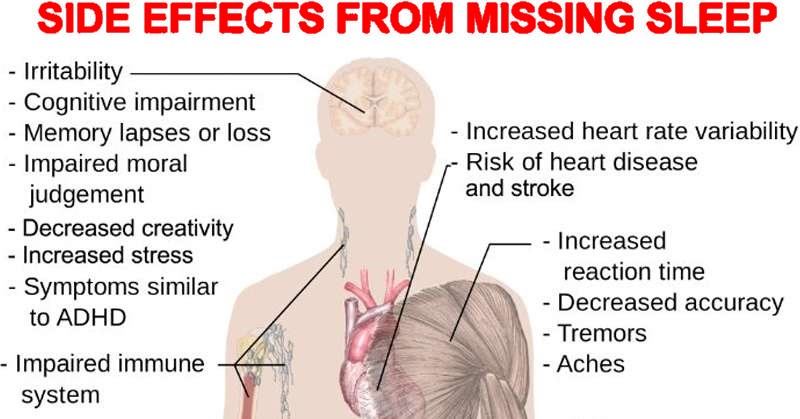
As seen in the picture above, sleep deprivation contains several side effects that can be detrimental to the human mind. While there may be some benefits such as a faster reaction time, that’s about as much of an upside to missing precious sleep time. A daily routine for a productive workday can sometimes be stressful normally. This is obviously, as expected, but combine that with these side effects, and you got yourself a difficult day ahead of yourself. Not only will you be overall less effective, but you’ll also be more irritated and less patient when doing so. Furthermore, you’re only hurting your body in the long run, so lacking sleep not only hurts you now, but it will definitely come back to hit you again later.

While sleep may make your life miserable, it may also have the most impactful symptom of any condition. Sleep deprivation has been proven to lower the life expectancy of individuals. The article from the source of the picture also provides more information to this as it states, “A report published in 2010 found that people who averaged 7 hours of sleep every night have the lowest mortality risk. Sleeping less than 7 hours or sleeping longer is associated with an increased risk of dying early. ” One of the main goals of an individual should be to live a long and healthy life, but sleep seems to get rid of both of these desires and give you an irritating life that doesn’t last as long as expected.

Now let’s focus on a large demographic is affected by this. College kids can particularly struggle from this lack of deprivation, as this is arguably one of the more stressful segments in a person’s life. Not only are you expected to succeed in school, but you’re also expected to create a routine for yourself that works out with very little experience to go off of. While this may not be the case for everyone, a large majority of college students have reported to suffer through these habits, and they make their lives much more difficult through this.
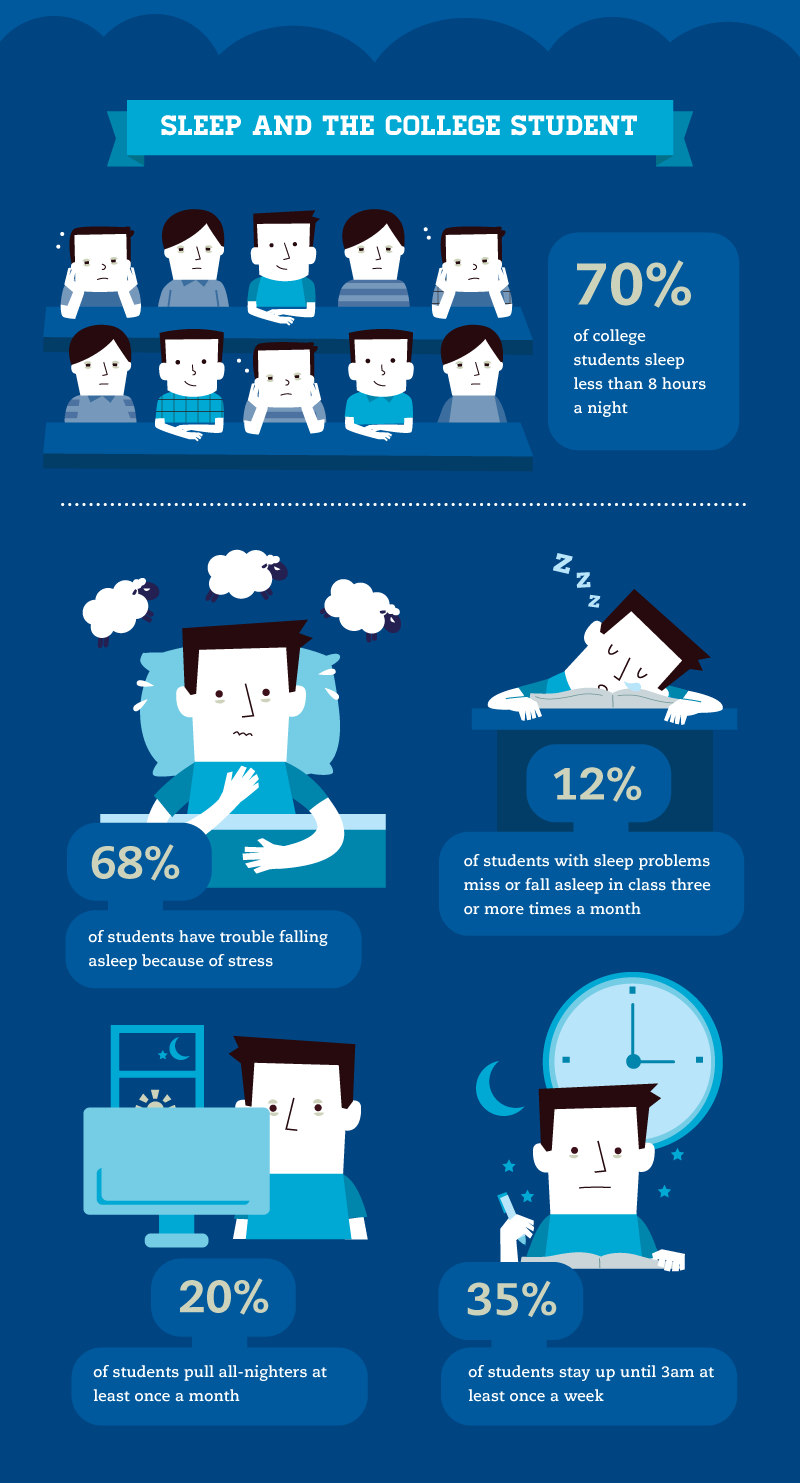
Source: https://www.slugbooks.com/guide-for-optimizing-college-sleep-cycle-infographic.html

If it wasn’t already clear enough that College students need sleep, the information graph on the right shows these correlations front and center. While some of these effects are seen in a portion of it, that still may be a large number of people, as 12% of ALL college students is still in the millions. This is without even mentioning that 68% of students have trouble sleeping, truly showing how much this impacts them for the worse. Seeing as how these habits are due to make them struggle on a day-to-day basis, these individuals may have a difficult time getting their schedule fixed. Not only can they not get work done as fast, but they will also have trouble sleeping. It’s this loop that affects students in for the worst, and these bad habits tend to carry on into their adult lives.

Now the real question is, how can we avoid this? Well it is obviously evident that getting more sleep would be the solution, but it’s a bit more complicated than that. The webpage “https://www.ninds.nih.gov/disorders/patient-caregiver-education/understanding-sleep” focuses on how to get out of the loop through various habits. They state that, “Setting up a schedule,Exercising 20 to 30 minutes a day but no later than a few hours before going to bed, Avoiding caffeine and nicotine late in the day and alcoholic drinks before bed, Relaxing before bed, and avoiding technology” is the best method of getting the amount of sleep you need.

While it may sound intensive and overly complicated, all it takes is a bit of dedication and motivation in order to go back to a healthy lifestyle. It obviously won’t happen in a day, but if it is done consistently throughout months, the change will start to occur, and your days will shine brighter than before. While many college students will usually point the blame on their stress and bad habits on their heavy workloads, they should also be looking at the other elephant in the room. Work may be difficult to handle at times, but it is also important to maintain your health to the same standard, as both your present and future depend on it.

What’s my purpose?

It isn’t usually brought up, but sleep takes up a large amount of our life. It’s vital to healthy living and staying productive, as it takes up about a quarter of your life. Despite this importance, sleep can sometimes be underestimated, specially when someone has a lot of work to do. This is specially prevalent during a student’s college years, as there is a great amount of work being distributed to them on the daily, and it can be overwhelming at times. Because of this, students might not get enough sleep, and this has a variety of consequences. Through this website, I hope to educate you how college students’ productivity is affected when they are sleep deprived, both physically and mentally.

Source Blogs #1 and #2

Brain Basics: Understanding Sleep. (2019, August 13). Retrieved fromhttps://www.ninds.nih.gov/disorders/patient-caregiver-education/understanding-sleep (Links to an external site.)

In this article, the National Institute of Neurological Disorders and Stroke (NINDS), along with other official branches of research groups have coincided to create an effort to investigate how the act of sleeping functions through a larger scale than just the surface level, as well as the various scientific and effects sleep can have on a person when they are responsible with their schedule. At first, the article starts with the general information on sleep, with the basic information that you should already know, such as how it’s important for everyday function and efficiency It also starts to bring up questions that the viewer will understand when they move on to the next section. Then, the focus starts to lean on the biological aspect of sleep. It goes on ahead to talk about the specific functions of each body part when sleeping, and what it does to maintain this action. Then we get more of the stages of sleep itself, which works on the stages of sleep and the mechanisms itself. From this the authors then go into how much sleep a person should get in order to maintain their effectiveness and be able to go throughout their day smoothly. This article seems to be written on various amounts of information that I have already heard before, and the information seems to match for the most part. It also goes into information that is much more specific such as the usage of multiple body parts in their research. From this, we just get a very clear idea of how information is managed through. Using this source, I can back up my claims and use it as a very reliable source of information for specific scientific facts. With other sources, I can use it to get into the introductory information required to get the reader into the topic with more knowledge.   


Sleep Deprivation and Deficiency. (2019). Retrieved from https://www.nhlbi.nih.gov/health-topics/sleep-deprivation-and-deficiency

This article goes more into the effects from a lack of sleep and how these can affect your daily life if you keep doing this. It obviously goes into the basic genetic effects of biology in sleep, but it goes through a different method of explaining it because it has a different audience overall. While the topics are the same, the article is much more easy on specific terms and wants the audience to know the beneficial information that they can use in their daily lives, such as tips for sleeping better and how much sleep they should get overall. Not only that, but it also goes more into the effects of sleep in a general term, by going into specific groups of people that may be affected, and general statistic facts that can greatly help an argument. Since it has multiple sections, it has a very large range of uses that it has in order to be used to back up an argument. Furthermore, it focuses more on a psychological basis rather than the biological basis of the previous research. Because of this, the sources can be used together to  combine multiple research efforts with both biology and psychology to provide an argument that has a strong foundation with bold claims. Both of these research methods are from organizations that work to benefit people without the need of having to advertise products or specific opinions, so it can be very good to consider a lot of the information provided to use in an argument or if you are to just simply improve your health with a better schedule for your days.  

Source Blogs #5 and #6

In order to get a better understanding of the new, revised topic that has been chosen, it was much better to divert the topic towards a certain group of people rather than a broad topic. In order to find out the cause and effects of sleep for college students, I used this source to show these factors. I assumed that the same things that are keeping up students at night might also be affected by the lack of sleep. For example, doing homework may take longer because of a lack of concentration and a larger focus for a desire of sleep, which leads to sleeping less, creating a cycle. The source goes into detail on the specific details and numbers that come into this major issue. For example, the article mentions that “Most college students are sleep deprived, as 70.6% of students report obtaining less than 8 hours of sleep.” Issues such as this are really put into the spotlight when numbers this high are implicitly written down. Furthermore, the article goes into specific aspects of sleep that are affected by this deprivation, as well as how other bad behaviors from college students affect sleep overall. This source uses a great variety of sources and quotes their scientific researches when needed, so I believe that its claims hold a great deal of merit. Since I needed to rework my question, I just needed a source that described the effects of sleep deprivation on college students. This, combined with my biological and psychological effects of previous articles can really show a strong argument for my topic question at hand.

McKoon, Katie. “A Day in the Life of a College Student.” CollegeXpress, www.collegexpress.com/articles-and-advice/student-life/articles/living-campus/day-life-college-student/.

I had felt that I may not be the most qualified to know exactly how a college student’s routine may be. Even if I were at that level in my learning, I may not know everything about how people go about their day since they may have a different schedule than what I do. Because of this, I found it best that I took some advice from a college counselor to get a better idea of how people go about their day. What the source does is very simple. It simply goes about describing how college life is for students from different colleges. These schedules start from when the students wake up until they go to sleep. While it may not originally seem the most useful, the source shows how much sleep a lack of sleep can hinder this schedule’s productivity. Since the previous sources show the biological and psychological effects of sleep deprivation, and the fifth source shows how specific actions of college students can hinder sleep even more, it is very useful to create connections between this schedule and that those statistics. With this, I am able to form a very concrete argument of how all of these effects come together to decrease the amount of productivity of your average college student. This source merely acts as a breath of fresh air to those other sources, and is unique on its own while also having its own usage and purpose. 

Source Blogs #3 and #4

Yang, Guang, et al. “Sleep Promotes Branch-Specific Formation of Dendritic Spines after Learning.” Science, vol. 344, no. 6188, 2014, pp. 1173–1178. JSTOR, http://www.jstor.org/stable/24743990. Accessed 5 Mar. 2020.

On the topic of sleep, this article written by Guang Yang focuses on diving into the more specific sections of sleep and how much sleep is affecting your body in a biological scale. In this scenario, the article creates its main point of interest by shrinking down in the human body to the neural scale. To begin, the article goes straight into diving into how neural networks connect with the amount of sleep an individual gets. From here, Yang then shifts their focus on their experimentation and conclusions based on these tests. After providing much more information on the effects that deprivation can have on dendrites themselves, the author provides visuals that further show the effects of sleep in each aspect of learning. Since this article focuses on showing how dendrites are affected by low levels of sleep, it can really be connected to how a college student might be affected due to this since there is a high emphasis on learning in the article. Due to this article consisting of many of these segments of very researched and thought out efforts, it is definitely a very useful source that can be used in a variety of situations for my specific argument. Since there are so many cases described and correctly cited, it really allows for me to have clear evidence to back up my points that sleep is an important to have. It works as just clear proof that my arguments have been confirmed through real-life experimentation and research. Due to this great amount of utility, I’m sure that it will be referred to when I wish to disprove a counterargument or strengthen a point. Since I have already chosen another source relating to the biological aspect of sleep, that one can be matched up with this article to provide a combined view from both authors that deals more with the actual question that I’m trying to answer.

Stickgold, Robert. “SLEEP ON IT!” Scientific American, vol. 313, no. 4, 2015, pp. 52–57. JSTOR, http://www.jstor.org/stable/26046350. Accessed 5 Mar. 2020.

Unlike previously referred sources, this new article focuses on multiple aspects of sleep from a broader scale for more general audiences. This article begins with our own interpretation of the importance of sleep, and how despite how long it has taken for us to reach this conclusion, it is still not perfect. From here, the author elaborates on this claim by going through a very thorough historical retelling of various consequences of sleep disorders. In one scenario, the article goes on to focus on fatal cases of insomnia, and how destructive this event can occur. What is unique about this article though is that it combines these historical events with brief presumed biological explanations for these events to further provide a clear visual image for the reader to understand. Overall, this article goes on to focus more on the negative consequences from a lack of sleep, which is definitely a change of pace from previous articles as they tended to focus more on the benefits of healthy sleep instead. This allows for the article to be used to show my reader how specifically important it is to have a healthy dose of sleep since they will understand not only the benefits of doing it, but also the consequences if they do not. This crucial connection is definitely allowing for a stronger claim and an overall better experience for the reader since they might have a better understanding of the elaboration that I will be trying to explain to them. Not only that, but the article also provides many visual images that are perfect to use in an argument so that the reader is able to actually see how everything is occurring rather than having a vague idea on their own. This sort of article is also perfect for counterarguments as it works to delete holes in my argument by further implying how important sleep can be for the human body.

Design a site like this with WordPress.com
Get started